Article by Alberto Martínez, CEO of Lantek
So reducing that gap is everyone’s job and implies gaining in competitiveness and productivity, and therefore in income and growth capacity. Let’s work together to ensure Spain is less dependent on services and transform the industry to underpin the country’s development.
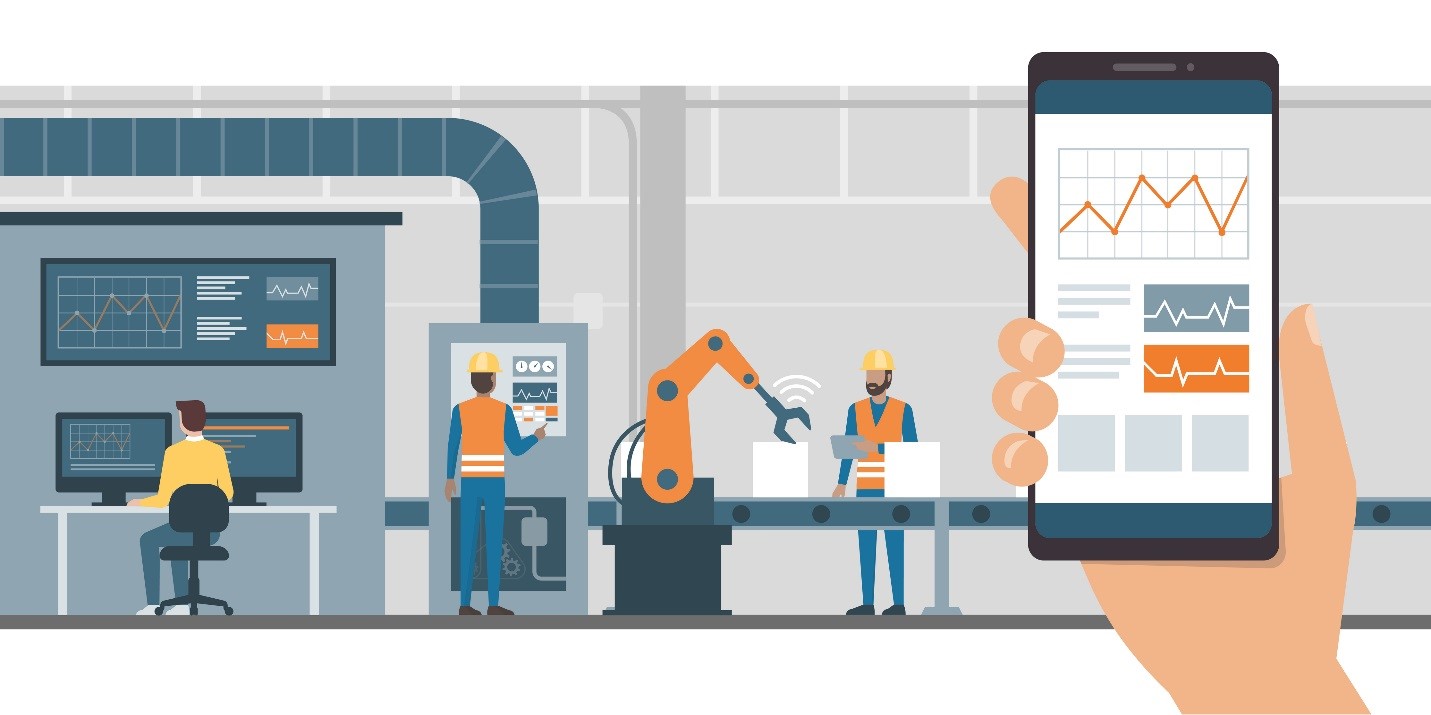
Before the advantages of this process in any industrial plant are detailed, do you know what this digital transformation is all about? It is the comprehensive connection of machinery, parts and processes with other players and with the customer. This connectivity will show the demand and the needs of production and power in real time, so that decisions can be made faster. Companies can get better performance from their plants and, consequently, save.
Having said that, these are the benefits of applying disruptive innovations in your factory:
- Optimize production: Through sensorization, advanced analytics and data management, artificial intelligence and the Internet of Things, connection of processes can be taken to another level. A software program processes data in real time and provides information about orders, stock and machine availability with a predictive capability that reduces errors, shortens deadlines and facilitates decision making. This is synonymous with cost reduction. A saving that the aforementioned Roland Berger report, sponsored by Siemens, quantifies at between 10% and 20%.
- Loyalty. Beyond production, digitalization has a double positive impact on your audience. On the one hand, it facilitates communication with customers, order customization and fast delivery; on the other, it improves your company’s image and increases visibility.
- Talent. Today’s workers are no longer loyal to a company. They do not mind moving. They want new experiences that allow them to grow professionally. They are also digital natives. They value well-being, labor flexibility and training possibilities. Because this fourth industrial revolution demands continuous learning to adapt to the new positions that arise with digitalization. Digitalization that acts as a magnet to retain and attract talent.
As mentioned at the beginning, if the added value generated by all these disruptive changes is added, your company will grow. According to the CEOE, digitized companies are 10% more productive, export double and double the creation of employment.
Although access to technology is now democratized and its cost is no longer high, it is increasingly important to seek reliable partners to offer a more comprehensive and complete service. Regardless of the size of your company, you need collaborators to develop and implement the technology needed to tackle digital transformation. Knowing how to choose the right partner or partners is crucial. This is one of the great challenges, which also demands a cultural and organizational change.
Do not therefore let the Industry 4.0 train escape - get help from those who have already climbed aboard and have the experience to make sure your plant is not out of the game. In a world where tourism, telecommunications and banking are already experiencing a real digital revolution, and where only those who adapt will win, it is now up to the industry to take a step forward.