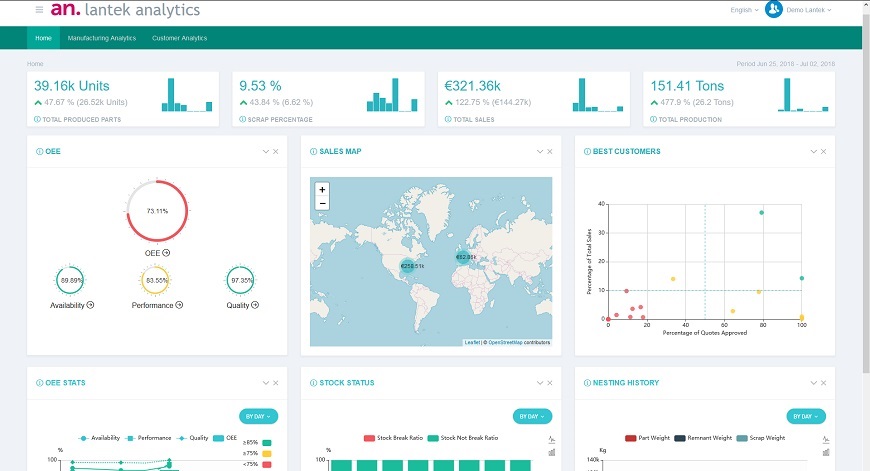
These enablers are used to monitor and optimize the production process simultaneously in all of its phases and in communication with all of the departments, from design to product delivery, via the management of stock, suppliers and clients.
Subsequently, the flow of information between all of the actors that participate in the supply chain, thanks to the integral connectivity of the productive process and the interaction of all of the links in the chain, turn it into a full digital network in which connection in real time and flexibility allow the Digital Factory to adapt with agility and speed to new user requests: customized products that are delivered in record time. This is quite a challenge in an environment that is increasingly competitive and which forces us to continue down the path of cost efficiency without affecting quality.
But in the Digital Factory of the industrial sector of sheet metal and metal, there are other elements in the supply chain. This is the orchestrated integration with the plant operation, with the CAD/CAM, MES and ERP programs, a coordination that results in operational and competitive improvements, with cost and time savings and increased productivity.
This was already stated in a report by PwC, which discussed the 2020 Digital Factory within a horizon of three years: connecting the Manufacturing Execution Systems with the Enterprise Resource Planning is a substantial improvement, but it should only be part of a broader digital environment. When companies also integrate the supplier and client information in real time, the potential to continue gaining in efficiency increases. "This integration strategy, both vertical and horizontal, not only allows for the optimization of process planning or the execution of production. It also strengthens the relationships between the company, its suppliers and its clients", explains said document.
Ultimately, the Digital Factory in the metal industry implies equipping the factories with intelligence by implementing the latest generation technological tools and integrating them with the operative systems that are used in order to achieve a truly digital supply chain. The objective is to optimize the planning of demand, production, the distribution network, the inventory and the ERP.
But it is impossible to address all of this if another fundamental part of the chain is not transformed: the people. It is key for the talent to adapt to the new reality, to be able to understand it and transmit it to suppliers and clients. Managing the change is certainly difficult and, to break down barriers, relying on training is crucial. The II Smart Industry 4.0 study, developed by Observatorio Industria, reveals that the most significant obstacles in industrial digitization are precisely the resistance to change and lack of training.
Digitization of the factory, step by step
Following all of this reflection, let’s summarize it in a schematic guide on how to transform the plant into a smart factory. The path leading towards the Digital Factory is long and we have to take it step by step and at an appropriate speed. It’s not so much about adopting each and every one of these technological enablers, but doing so progressively and with our objectives well-defined.
This way, and once again using the PwC report and our expertise as pioneers in the digital transformation of the sheet metal and metal sector as a reference, the phases necessary in the sheet metal sector in order to digitize the supply chain and turn the plant into a Digital Factory are as follows:
Never before have the different links of the supply chain been so integrated. Nowadays, the connectivity of machines, processes and programs allow it to be digitized so that it operates in a choral manner, optimizing the plant and promoting collaborative environments among all of the actors involved in the digital supply chain, the raison d’être of the Digital Factory.