Quick turnaround times can be difficult to meet and high-batch jobs are but a dream. In recent years (relatively speaking), the introduction of sheet metal laser cutting technology has made achieving high levels of accuracy attainable. Up until very recently, the investment in these machines has been steep, with manufacturers having to decide whether the ends would justify the means. For custom fabricator Laserfab, based in Lebanon, Pennsylvania, there was no question about the means and the ends, which have far exceeded their expectations.
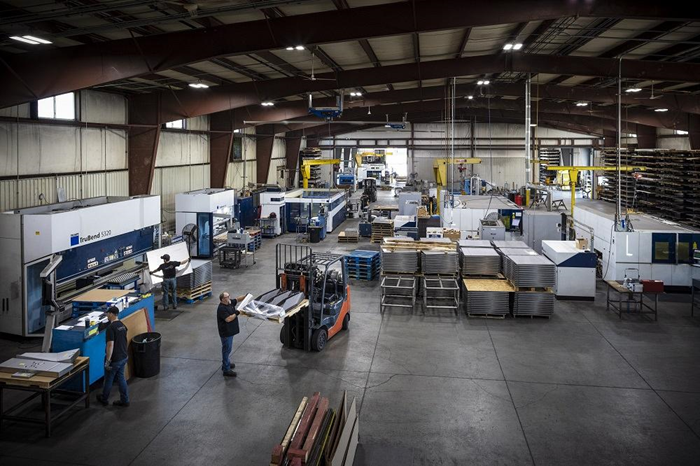
Laserfab’s specialises in laser cutting and CNC bending. Dain Zimmerman, Director of Business Development, says, “We supply OEMS, tier one suppliers and other fabricators with laser cut and folded parts and 17 out of the company’s 27 employees are on the shop floor operating five Trumpf and Eagle laser cutting centers and three Trumpf press brakes. The shop handles orders of all sizes for many different industries including for aerospace, entertainment, transport and industrial applications. To meet growing demand, we have hired three more shop workers and the higher volumes led us to add a night shift in 2022.”
The company’s growth has been rapid, and Zimmerman understood that employee buy-in to changes in working practices necessary for the expanding company had to be managed. Previously, employees understood their own functions, but not those of their colleagues. Additionally, workflow was tracked using spreadsheets and accounting software. Much valuable time, which ate into production resources, was spent making sure everyone understood and were happy with the implications of the necessary changes that would result from investing in ERP.
The company chose Lantek software, implementing Lantek Integra, MES Manager and Expert – the key benefit being that the software is designed and developed for sheet metal business and it felt it was tailor made for Laserfab’s operation. Handling all its ERP, MRP and CRM functions as well as nesting, programming and planning in one system was a major advantage.
Zimmerman says, “Having one system that manages all aspects of our business makes our operation considerably more efficient.” Lantek MES captures data from the shop giving consistent data throughout manufacturing, sharing it with the other software modules. Starting with the order it holds and keeps a record of all the manufacturing data such as machines used, material type and thickness, purchasing as well as other operations such as folding and welding. With this information everyone has an overview of the business, so they fully understand the part they play and how it fits into the success of the business.
Project Management
Laserfab frequently produces complex jobs which require outsourced operations such as powder coating or finishing. Lantek MES keeps control of this information, reducing the time to keep these tasks on track by hours.
“If I have a part that we’re going to laser cut and bend and deburr ourselves but outsource the machining and coating, having all of that data collected within one sales order keeps information moving and deadlines on task,” said Zimmerman.
Quality is important at Laserfab and it uses fiber laser technology. Its improved cutting power results in a smoother finish with minimal imperfections and heat related distortion and the ability to achieve tolerances down to +/- 0.005 inches. The machines themselves require less maintenance, making them ideal for high volume jobs. Zimmerman says, “Shims used in warehouses are ordered in several different varieties, but all in the same material so with the fibre lasers we can cut them in lots of thousands of parts.”
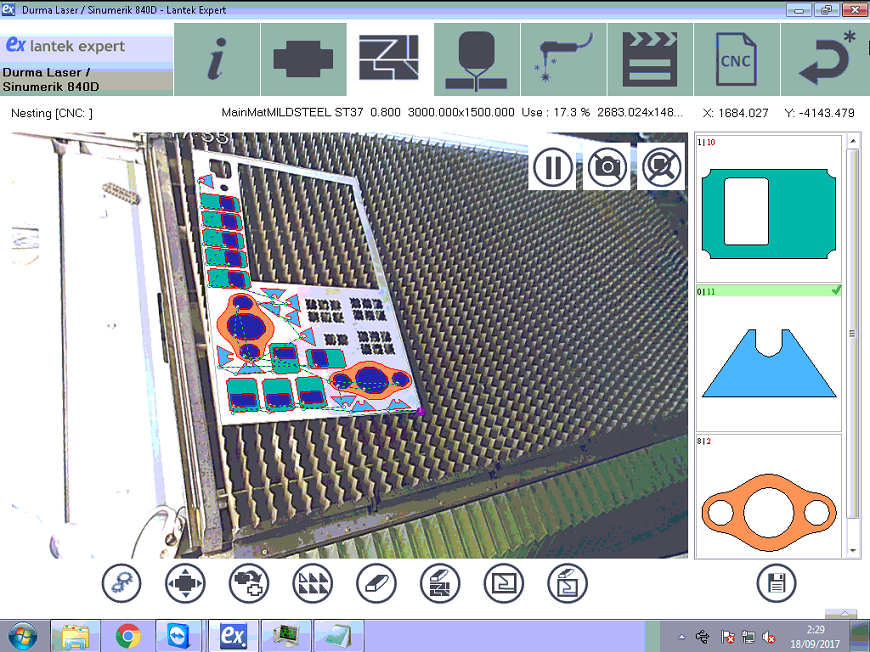
When an order arrives, the customer’s part number, material type and thickness go into the sales order which is attached to the downloaded CAD file. Nesting is done in Expert Cut which also generates the CNC code for the fibre lasers. Within the CAM software the engineers can visualise the imported model, fix any errors or alert the customer should there be manufacturability issues. Within the nesting there are options for automatic and manual nesting enabling the engineers to copy move or rotate the 2D model as necessary to optimize material utilization.
In the nesting software, where the material is the same, the company can dynamically nest parts form multiple customers in the one nest maximizing material savings. Zimmerman adds, “When it’s sent out to production, it automatically comes up to the selected laser so the operator knows where to cut the parts and validate them. As soon as they’re validated, the system automatically alerts the next process. The whole thing keeps moving. At the end, when the shim arrives to shipping, everything is perfect and aligned and ready to be sent out according to customer specifications. There’s no confusion.”
The ability to catch machinability problems at the cost estimation stage is a significant time saver. Zimmerman says, “It’s our process here to have the cost estimators completely review and validate the machinability of the .DXF or CAD file. We never used to do this, and we’d leave it up to the programmer to catch. If there was a mistake, it ended up causing too much disruption and lost productivity.”
Completed jobs, their nests and every detail of their manufacturing processes are stored in the system. The ability to analyze this information is a very valuable source of historic data, showing manufacturing efficiencies and inefficiencies for every stage. This data can be used for cost savings in everything from purchasing to winning new business. For Laserfab, which has been using the software since 2014, every job has been documented. “As you grow and scale, you have more opportunities and more instances where you need that historical information. This saves you a lot of time,” said Zimmerman.
A Smart Operation
Laserfab’s ERP/MES/CMM installation has enabled the company to realise its concept for manufacture, unifying the objectives of everyone in the company for success. Maintaining its vision of just dedicated cutting and folding and not adopting secondary operations in-house such as painting or machining has focussed thinking on a tight operation with two to four week turnaround.
“By integrating the computer system, you’re able to flatten that information and spread it throughout your organization so that everyone has the same information at the click of a mouse,” said Zimmerman. “You can then make decisions together – and separately – that are aligned with the company’s goals. The software does whatever you tell it to do so you still need a good strong team to understand it and the context.” Zimmerman was also quick to point out that the software works at its absolute best when there is a good healthy work culture.
“I think the hallmark of the Lantek software is to break down silo thinking and action as it relates to everyone doing their own job. We are all doing the same job – to please our customers – and the software gets you there.”