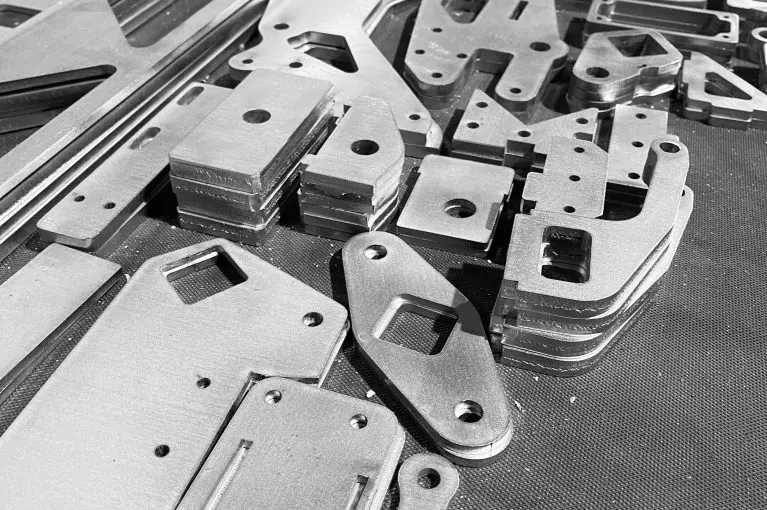
The Worcester based company is a one stop shop, with both fabrication and machining capabilities, designing and manufacturing a range of attachments for excavators, diggers and tractors, as well as farm and factory structural steel buildings. Part identification is crucial during the manufacture and build of these products, with many very similar components. This own product aspect of the business takes up around half of the capacity, with the remainder filled with subcontract work.
Harry Hodgetts says, “We were already aware of Lantek and chose it without hesitation because it met all our needs. The decision was straightforward. Laser cutting allows us to handle a variety of materials, and with the software, we can seamlessly import customers’ CAD files into the Expert software. The majority of our work is cutting mild steel between 2mm and 30mm thick and stainless between 1mm and 10mm thick. The machine has a shuttle table so we can unload parts while the machine is cutting the next sheet. With Lantek’s nesting we can tag parts in the sheet and nest parts in larger holes, which would otherwise be scrap, add the odd part in a spare area, and have the flexibility to use up remnants of material, maximising our material utilisation.”
The subcontract side of the business has required A13 Engineering to generate a large volume of quotations. Previously this was done using a series of spreadsheets which took over 20 minutes for each quotation. By adding Lantek iQuoting the time has been reduced to 5 minutes. The software holds material prices and allocations of material. Nesting and machining times are simulated as is gas use. Harry Hodgetts adds, “iQuoting is in the Cloud so can be operated from anywhere creating a quotation around 10 times faster than we could do previously and much more accurately. Gas usage is a big variable cost which is highly job dependent. Stainless steel and aluminium use a lot of gas for example. We have done trials and found that the usage calculated by iQuoting is very close to what we actually use.”
The Lantek software can aggregate multiple materials and thicknesses from subcontract enquiries and orders, automatically splitting them out so that nests can be created in sheets or remnants, mixing parts from different customers in the same type of sheet, showing what is left and giving A13 the ability to add individual extra parts, if it chooses, to fill the sheet completely.
Once completed, iQuoting generates a pdf quotation which is emailed directly to the customer. When the order is received, all the manufacturing information is already in the system so the job simply needs to be released to the workshop ready for manufacture.
Harry Hodgetts says, “The support from Lantek has been excellent both online and in person, helping us to get the best out of both the machine and the software. As Lantek can program many different makes and technologies of sheet metal machinery, we are also well-prepared for any future investment we might make, such as tube cutting machinery. In our fast-paced industry, Lantek Expert and iQuoting have become indispensable to us. Has it been a benefit to us? Absolutely.”