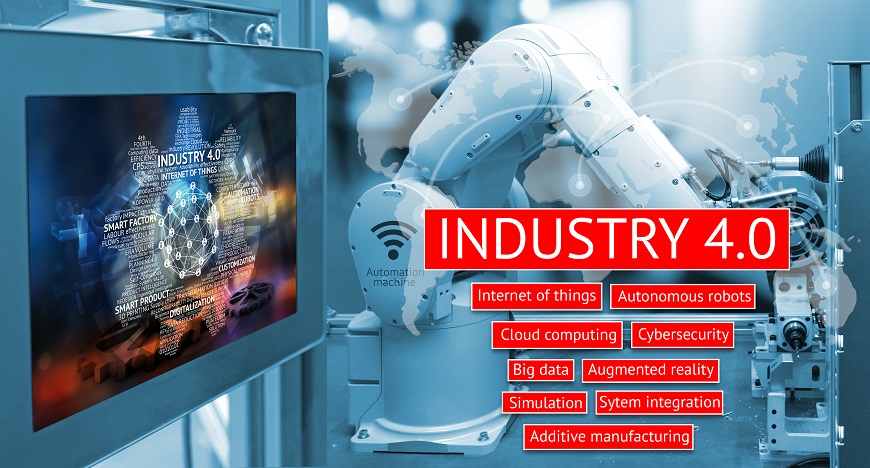
As part of its ongoing development Lantek has developed the tools to get companies on the road to Industry 4.0.
“In a nutshell, Industry 4.0 looks at the whole of a manufacturer’s business and incorporates intelligence and autonomous decision making into the mix to produce a ‘smart factory’.”
Many companies are already using automation such as automated machine loading and unloading systems, tool change systems or in process measurement. Industry 4.0 is aimed at expanding this to link to the complete factory administration.
Within Lantek’s software for example, there is a customer relationship management module which records the history and details of each client. The system also has details of material prices, component prices and external process costs as well as the costs for each process within the company. From this information and the physical shape and design of the part to be made, the software can analyse the job and produce an accurate quotation extremely quickly and virtually automatically. Some of Lantek’s customers produce upwards of 800 quotations per month.
Once the order comes in, this information together with details such as delivery dates and special requirements is passed to the workshop.
As work progresses, data collection systems close the loop and record where the job is, how long it has taken and additionally resolve problems such as scrapped components, automatically adding them back into the production schedule. Already, with these types of feedback loops the software is autonomously taking decisions which would otherwise require human intervention.
Closing the loop and feeding information back to managers also enables comparison between the quoted and planned processes and what is actually happening. Not only does this ensure better products but it also checks that parts are being made at a profit, only flagging up exceptions which require managers to take some action. In addition, the system learns from this information so that future quotations and planning can be even more accurate.
With the information that is being gathered, managers can look at the productivity of individual machines and processes giving them the ability to make informed decisions about changes to methods or investment in new equipment. By automatically running the majority of day to day tasks and making automated decisions a company’s administrative load will be greatly reduced, the chance of human error largely eliminated and productivity will increase.
Many machine manufacturers are looking at more ways of developing tools for Industry 4.0. For example, some are already connect via the internet to the manufacturer so that essential maintenance can be carried out or early warning of breakdown predicted - just some of the possibilities within Industry 4.0.
Rob Powell concludes, “This is a very exciting time for manufacturers as, by embracing Industry 4.0, most of the errors, delays and cost overruns, which are a common problem, will be eliminated through automation and automated decision making. The result will be a new way of working where productivity and profitability is higher and there is time and data available for planning strategic improvements to a business.”